
Parenting a teen through intense emotional outbursts? Learn how to support your adolescent and build calm with local guidance from Midland, NC therapists.

If you are parenting a teenager, you have likely had those moments where you feel completely out of your depth. One minute, everything is calm. The next, a casual question about homework or dinner plans triggers an emotional reaction so intense it feels like a sudden, violent storm.
In those moments, it is incredibly easy to feel frustrated, alarmed, or even rejected. You might find yourself thinking, Why is everything such a big deal? or Why are they acting so dramatic?
But to the parent of a teenager who feels like their emotions are a tidal wave, here is what you need to know: they are not "too much," and they are certainly not broken. They are simply learning to steer a very heavy ship in a massive storm.
At Intentional Growth Behavioral Health Services, we work with families across Midland, Cabarrus County, and the surrounding areas navigating this exact terrain. Let’s break down what is actually happening beneath the surface of these emotional tidal waves, and how you can help your teen navigate them without getting swept away yourself.
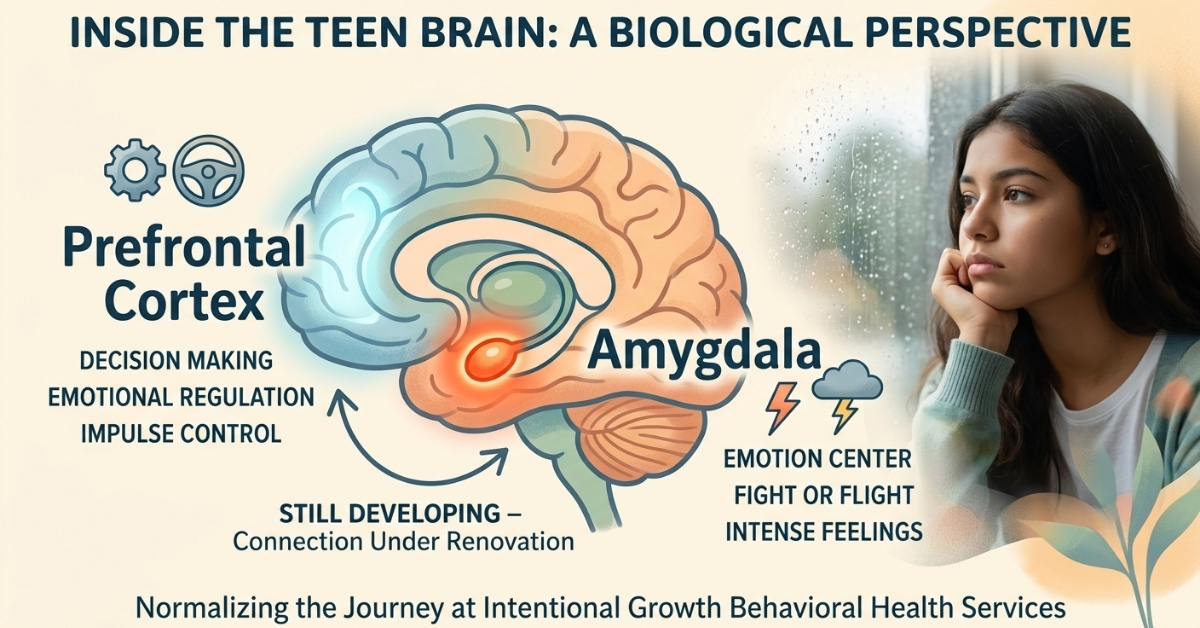
To understand why teenagers feel things so deeply, we have to look at what is happening inside their heads. During adolescence, the brain is undergoing a massive, ground-up renovation.
The emotional center of the brain—the amygdala—develops much faster than the prefrontal cortex, which is responsible for impulse control, logical thinking, and emotional regulation. In short, the "engine" of their emotions is fully functional and running at maximum horsepower, but the "brakes" and "steering wheel" are still being built.
When your teen experiences a social setback, a bad grade, or a shift in a friendship, their brain processes that event with the volume turned all the way up. It’s not that they are choosing to overreact; their nervous system is genuinely perceiving these everyday stressors as highly intense events. Recognizing that this is a biological developmental stage—not a behavioral choice—is the first step toward finding your own patience.

When a teen’s emotions are loud, overwhelming, or erratic, society often labels them as "difficult" or "moody." Well-meaning adults might tell them to "calm down," "stop being so sensitive," or "grow up."
However, when teens consistently receive the message that their feelings are too intense, they begin to internalize a damaging narrative: Something is wrong with me. They start to believe that their internal compass is fundamentally broken.
Our goal as parents and supportive adults isn't to shut down these emotional waves, but to normalize them. When we tell a teen, "It makes sense that you feel overwhelmed right now," we validate their reality. We show them that their emotions are not dangerous, and that they are capable of feeling deeply without drowning. They aren't "too much"—they are just experiencing a lot of "new."
So, how do you actually show up when the storm hits? It is one thing to understand the brain science, but it is another to stay calm when your teenager is slamming doors or crying inconsolably. Here are a few ways to be a grounding presence:
Don't match their volume. If your teen is at a high emotional intensity and you meet them at that same level, the storm only grows. Practice taking a deep, visible breath. Your calm nervous system can help co-regulate theirs.
Listen without immediate fixing. As parents, we hate seeing our children struggle. Our instinct is to jump in with advice, solutions, or logical arguments. But during an emotional tidal wave, the logical brain is temporarily offline. They don't need a project manager; they need a safe harbor. Try saying, "I'm just here to listen. You don't have to figure it out right this second."
Separate the feeling from the behavior. It is entirely okay to validate a feeling while holding a boundary on behavior. For example: "I understand you are incredibly angry right now, and it’s okay to feel that way. It is not okay to speak to me disrespectfully. Let's take a break and talk when we're both calmer."
When tension is running high, having the right words ready can de-escalate a confrontation before it spirals. Here are quick script shifts you can use during an outburst:
Learning to manage emotions is a skill, much like learning to drive a car or play an instrument. No one expects a novice driver to navigate a mountain pass in a blizzard on their first day behind the wheel. Yet, we often expect teenagers to have perfect emotional control without giving them the grace to practice and make mistakes.
By shifting our language from fixed labels ("You're so dramatic") to learning-oriented language ("You're dealing with some really big feelings right now, and we're going to figure out how to navigate them together"), we foster resilience. We remind them that emotional regulation is a journey, not an overnight switch.
As you move through this week, try to notice your own reaction when your teen’s emotions start to rise. Do you feel an urgent need to fix it? Do you feel defensive or frustrated?
Take a moment to pause, take a breath, and remind yourself: They are not trying to give me a hard time. They are having a hard time.
In-person care in Midland, NC, serving Cabarrus County, the greater Charlotte area and statewide via Telehealth.
Parenting a teen through intense emotional waves isn't something you have to navigate alone. While home co-regulation strategies make a world of difference, professional guidance can provide your teen with tailored, concrete tools for emotional regulation, stress tolerance, and healthy communication.
At Intentional Growth Behavioral Health Services, located in Midland, NC, we specialize in helping adolescents and families build resilience, understand behavioral health challenges, and strengthen their relationships.
Whether you live locally in Cabarrus County areas such as Concord, Harrisburg, or Mint Hill, or are located anywhere across North Carolina, we're here to help:
In-Person Therapy Sessions: Conveniently located at our Midland office for face-to-face care in a safe, tranquil environment.
Telehealth Options Available: Flexible, secure online therapy sessions so your teen can receive professional care from the comfort and convenience of home anywhere in North Carolina.
Ready to help your teen find calm in the storm?
Reach out to Intentional Growth Behavioral Health Services today to schedule an initial consultation or learn more about our adolescent counseling programs. Together, we can help your teen steer through the storm toward lasting growth.


