
Struggling with public child meltdowns? Discover neuroscience-backed co-regulation tips to calm big emotions without feeling judged as a parent.

It’s a scene almost every parent knows too well. You are in the middle of a crowded store, trying to check off the last few items on your list, when it happens. Your child collapses into a puddle of tears, screams, and thrashing limbs because of a minor transition, a boundary you set, or seemingly nothing at all. Instantly, you feel the heat rise in your neck. You sense the eyes of strangers on you, judging your parenting, your boundary-setting, or your child's behavior.
In that moment, it is incredibly easy to feel a deep sense of isolation and shame. A quiet voice inside whispers, If I were a better parent, this wouldn't be happening.
But here is the truth we need to shout from the rooftops: your child's public meltdowns are not a reflection of your worth as a parent.
Having a child who struggles with big emotions can feel incredibly isolating. However, those intense outbursts are not proof of "bad parenting," they are a normal, albeit highly stressful, part of human development. Let’s look at what is actually happening during these emotional storms, how we can support our kids, and most importantly, how we can offer ourselves some much-needed grace.
To change how we react to big emotions, we have to understand where they come from. Children do not have fully developed brains. Specifically, the prefrontal cortex, the area of the brain responsible for impulse control, logical reasoning, and emotional regulation, is under construction well into young adulthood.
When a child experiences a meltdown, they aren't trying to manipulate you or embarrass you. Their nervous system has perceived a threat or an overload of sensory input, sending them straight into a fight-or-flight response. Their amygdala (the emotional alarm system) has taken the driver's seat, completely offline from their logical brain.
During an amygdala hijack, a child cannot "just calm down" or listen to reason. They are physically incapable of doing so. When we see their behavior through the lens of a struggling nervous system rather than a behavioral rebellion, our response can shift from anger to empathy.
When our children are dysregulated, our survival instinct as parents is often to control the situation. We might try to bribe, threaten, or demand that they stop crying. But trying to force a dysregulated child to regulate is like trying to put out a fire with gasoline. It only escalates the stress in the room.
Instead of trying to control the behavior, our primary job is to offer connection. This is a concept known as co-regulation. Because children cannot regulate their own nervous systems yet, they rely on our calm, grounded presence to help them soothe theirs.
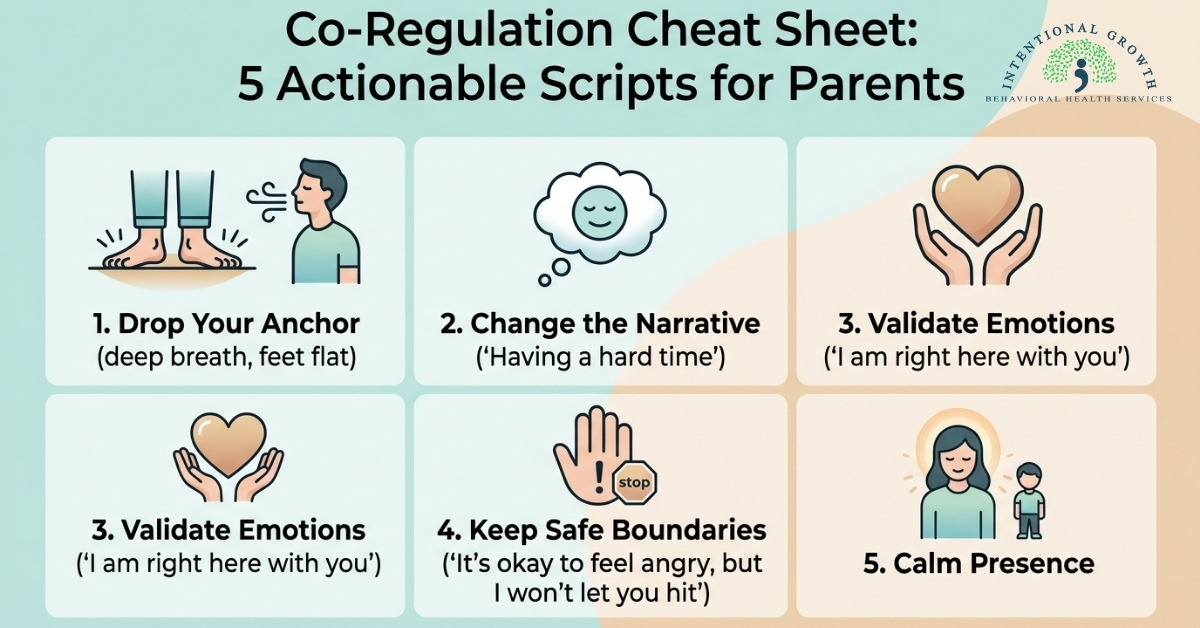
Here is what this shift looks like in practice:
By validating the emotion while keeping the boundary safe, we teach our kids that their feelings are not dangerous or bad, even when they are incredibly uncomfortable.
Learning to co-regulate with your child is a practice that takes time and support. If you’re feeling burned out or unsure how to navigate your child's big emotions, our team at Intentional Growth Behavioral Health Services is here to help you build a personalized toolbox for your family.
Explore our family counseling & parent support services →
One of the hardest parts of managing a child’s big emotions is doing it in front of other people. The perceived judgment of onlookers can trigger our own nervous systems, throwing us into fight-or-flight right alongside our kids.
When you feel that familiar spike of panic in public, try these grounding strategies:
Drop your anchor: Take one deep, slow breath. Feel your feet flat on the floor. Remind yourself, I am safe, and my child is safe.
Change the narrative: Instead of thinking, Everyone thinks I'm a terrible parent, repeat a mantra to yourself: My child is having a hard time, not giving me a hard time.
Acknowledge the glare, then let it go: If people are staring, remember that their reaction is a reflection of their own stories, expectations, or stress, not your parenting skills. Your only responsibility in this moment is to yourself and the little human in front of you.
True emotional resilience isn't built during the height of a meltdown; it is built during the calm, quiet moments of connection.
To help your child navigate big emotions over time, try integrating these habits into your daily routine:
Name the feelings: Use emotional vocabulary often. "I noticed you felt frustrated when that block tower fell. That makes sense."
Normalize all emotions: Let your children see you experience and manage your own big feelings. "I'm feeling a little overwhelmed right now, so I'm going to take three deep breaths before we try this again."
Create a "peace corner": Instead of a time-out chair, set up a cozy space with pillows, books, or sensory toys where your child can go to feel safe and calm down when they feel overwhelmed.
Parenting is not about raising a child who never cries, never screams, or never struggles. It is about being a safe harbor for them when the storm hits. The next time you find yourself navigating a wave of big emotions, take a moment to offer yourself the same compassion you extend to your child. You are doing hard, sacred work, and you are doing a wonderful job.
Reflect on this today: What is one small way you can extend grace to yourself when your child is struggling? If this resonated with you, consider saving this post for the next time you need a reminder, or sharing it with a fellow parent who might be feeling a bit isolated in their journey today.
Parenting through big behavioral challenges and emotional regulation struggles can leave you feeling exhausted and isolated. While self-compassion and co-regulation tools are powerful first steps, having professional guidance can transform your home's daily dynamic.
At Intentional Growth Behavioral Health Services, we specialize in helping families navigate child emotional regulation, anxiety, and behavioral stress with personalized, compassionate support. You don't have to navigate this path alone, reach out to our team for a warm, low-pressure consultation whenever you're ready.


